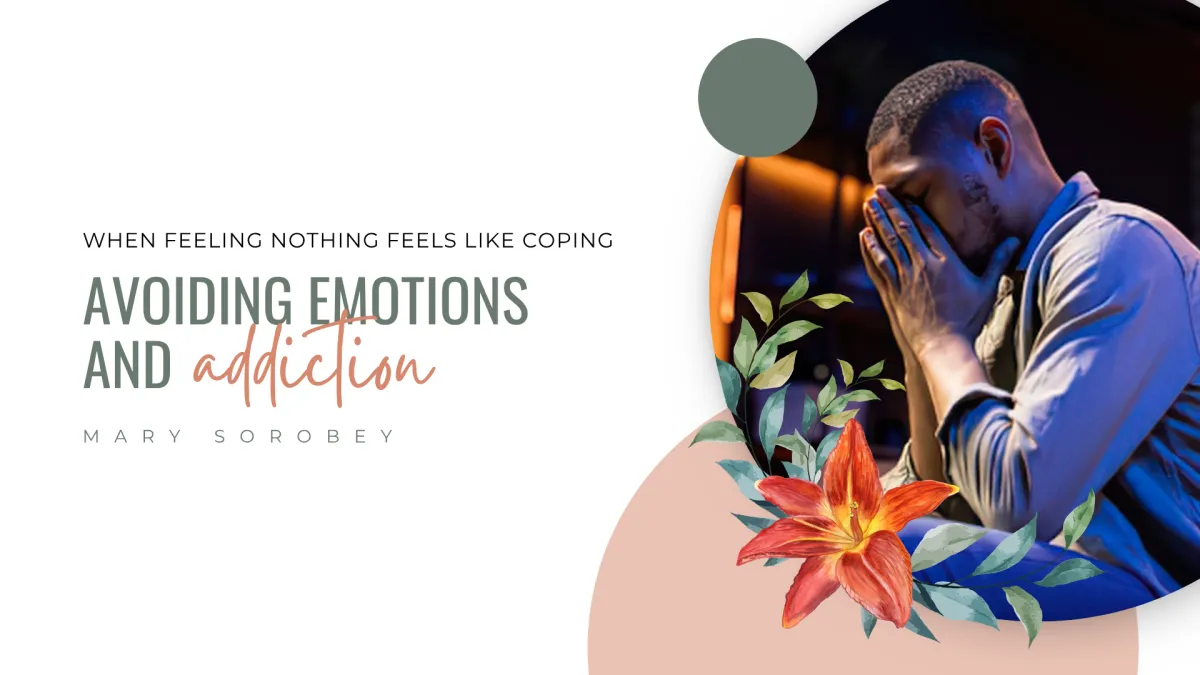
Avoiding Emotions & Addiction | Sorobey Psychology Edmonton
You got through the week. You hit your deadlines, made dinner, answered the emails, kept the house running. And then, somewhere around Thursday evening or maybe Sunday night when things got quiet, you poured a drink, took something, or lost two hours to something you can't quite account for. Not because you wanted to. Because you didn't want to feel what was waiting.
That's not weakness. That's one of the most human things there is.
But if it's happening more often, if the drink is getting bigger or the numbing is getting more creative, it's worth asking a question most people spend years avoiding: what exactly are you trying not to feel?
Avoiding emotions and addiction are more connected than most people realize. Not as a cliché, but as a clinical reality that shows up in the lives of people who, from the outside, look completely fine.
What Is Emotional Avoidance — And Why High-Functioning People Are Especially Vulnerable
Emotional avoidance is exactly what it sounds like. It's the pattern of moving away from uncomfortable feelings rather than moving through them. That might look like staying busy to the point of exhaustion. It might look like intellectualizing everything so nothing actually lands. It might look like a glass of wine that becomes a bottle, or a prescription that becomes a habit.
Here's the thing that most people in this situation don't realize: emotional avoidance isn't a character flaw. It's a learned strategy. At some point, it probably worked.
If you grew up in a home where emotions were dismissed, punished, or simply not talked about, you learned to manage them internally. If you work in a high-stakes field, maybe as a first responder, a lawyer, a nurse, a team leader, you've likely been trained to stay composed under pressure. Feelings get filed away because there isn't time, because the job demands it, because other people need you to hold it together.
That capacity is real. It's even admirable, in the right context.
The problem is that unfelt emotions don't disappear. They compound. And the strategies people build to keep them at bay, substances, compulsive behaviours, constant distraction, have a way of becoming the very thing that traps them.
The Professional Who Has It Together
High-functioning adults are a particularly vulnerable group when it comes to avoidance behaviour and addiction, for a reason that isn't obvious. Because they're capable. They can hold a career, a family, a social life, and a drinking problem or a painkiller dependency in the same hands, for a long time, before anyone notices, including themselves.
The competence that helps them succeed also makes it easier to rationalize. "I'm managing fine." "I'm not like the people who really struggle." "I just need this to take the edge off, and then I'll cut back."
That edge is the feeling. And the cutting back keeps not happening.
What Alexithymia Has to Do With This
Some people who struggle with avoiding emotions and addiction have genuine difficulty identifying what they're feeling in the first place. This is called alexithymia, and it's more common than most people know, particularly among those with trauma histories or certain occupational cultures.
If you've ever been asked "how do you feel about that?" and genuinely didn't know, or if emotions tend to show up in your body first (tight chest, jaw tension, restlessness) before you have any words for them, this might resonate. It's not that the feelings aren't there. It's that there's a gap between the experience and the ability to name or process it.
Substances and compulsive behaviours can fill that gap temporarily. They offer a kind of emotional shortcut: instead of the complicated, uncertain work of feeling something, you feel reliably numb, or reliably calm, or reliably something.
The Hidden Link Between Avoiding Emotions and Addiction
There's a model in addiction research sometimes called the "affect regulation model," which essentially argues that many people use substances not primarily for pleasure but for emotional management. They're not chasing a high. They're quieting something uncomfortable.
This distinction matters enormously, because if you treat the substance use without addressing the underlying emotional avoidance, you're pulling one thread while the rest of the knot tightens.
Suppressing feelings and substance use are cyclically linked. The more a person avoids, the more their emotional tolerance drops. The less tolerance they have, the more they need to avoid. The more they use to avoid, the more shameful and overwhelming the feelings become when they surface. And so the cycle locks in.
Trauma sits at the center of this for many people. Unprocessed grief, childhood neglect, a traumatic experience that was never given space, these don't resolve on their own. They wait. They show up sideways, as irritability, as disconnection, as the vague and persistent sense that something is wrong but you can't name it. Numbing emotions with alcohol or other substances can feel like the only thing that brings relief, precisely because the original wound was never treated.
Why This Isn't About Willpower
Here's an uncomfortable truth that actually brings most people relief once they hear it: the fact that you can't just stop using willpower isn't a failure of your character. It's evidence that your nervous system has learned to need the avoidance strategy.
You can't think your way out of an emotional pattern that exists below the level of thought.
What changes things is learning, often for the first time, to tolerate discomfort without immediately fleeing it. To notice a feeling, name it, sit with it long enough that it can pass through rather than accumulate. That's not a matter of wanting it badly enough. It's a skill that takes time, support, and the right clinical approach to build.
How Emotional Avoidance Keeps the Addiction Cycle Spinning

Picture the moment right before you pour the drink or take the pill or start the behaviour that you know, somewhere, has gotten out of hand. What's happening in the seconds before?
For most people in this pattern, there's a trigger. A conflict with a partner. A performance review that went sideways. A Tuesday night that's just too quiet. A memory that surfaced unexpectedly. The body reads it as a threat, the nervous system activates, and the urge to do something to make that feeling stop arrives fast and with considerable force.
The substance works. In the short term, it actually does what it promises.
That's the trap. Because what gets reinforced every single time isn't relaxation or pleasure. It's avoidance. The brain learns: when discomfort comes, this is what we do. And the threshold for what counts as intolerable discomfort gets lower and lower.
Using substances to cope with stress isn't a rational decision at that point. It's an automated response. A reflex that has been practiced thousands of times until it feels involuntary.
This is why fear of vulnerability in addiction runs so deep. Opening up, feeling the feelings, sitting with uncertainty, these things feel genuinely dangerous to the nervous system that has been organizing itself around avoidance. It's not drama. It's physiology.
Signs That You May Be Using Substances to Outrun Your Feelings
You may have noticed that you reach for something when a conversation gets too close to something real. You may have found that you can discuss a painful situation in your life very calmly, almost clinically, but feel nothing that matches the weight of what you're describing. You might feel more comfortable when things are busy, and faintly panicked when they're not.
Some patterns worth sitting with, without judgment:
You feel relief when plans are cancelled, not because you're introverted, but because being alone with your thoughts has become something you manage rather than something you allow. You've described yourself as "fine" so many times in response to things that weren't fine that the word has lost all meaning. You're better at talking about what you think than what you feel. When you do feel something strongly, the first instinct is to do something, anything, to make it stop. The idea of going a few days without your substance or behaviour brings up a level of anxiety that surprises you.
None of these are diagnoses. They're observations. But if several of them landed, it might be worth reading more about our addiction assessments in Edmonton, which are designed to help you understand what's actually happening, without pressure, without judgment, with clinical precision.
Why This Matters Now, Here, in Edmonton

Edmonton winters are not gentle. Long dark months, sustained cold, real geographic and seasonal isolation for many families and professionals, these aren't minor lifestyle factors. They're genuine stressors, and they can quietly intensify the very conditions that make avoidance behaviour and addiction harder to see clearly.
High-functioning adults in Edmonton often carry enormous professional and familial responsibility in a culture that values self-sufficiency. Asking for help isn't always easy here. The instinct to manage privately, to handle it internally, to not let on that something isn't working, runs deep.
There's also a practical reality: many people who need support haven't found a setting that fits their life. Traditional treatment models, the ones that require you to step away from work and family, simply aren't accessible for a parent who has children at home, or a first responder who needs to maintain their professional status, or an executive who can't disappear from their responsibilities for thirty days.
That's exactly why outpatient models exist. You don't have to choose between getting better and staying present in your life.
Learning to Feel Again: What Addiction Treatment Looks Like When Emotions Are the Root
Treatment that actually reaches the emotional avoidance underneath the addiction looks different from treatment that simply focuses on stopping the behaviour. Both matter. But one without the other tends to be short-lived.
At Sorobey Psychology Centre in Edmonton, the clinical work is built around this understanding. The goal isn't just sobriety or reduced use. It's a sustainable shift in how you relate to your own internal experience.
Cognitive Behavioural Therapy (CBT) for Emotional Avoidance
Treatment that actually reaches the emotional avoidance underneath the addiction looks different from treatment that simply focuses on stopping the behaviour. Both matter. But one without the other tends to be short-lived.
At Sorobey Psychology Centre in Edmonton, the clinical work is built around this understanding. The goal isn't just sobriety or reduced use. It's a sustainable shift in how you relate to your own internal experience.
Cognitive Behavioural Therapy (CBT) for Emotional Avoidance
CBT for emotional avoidance focuses on identifying the specific thought patterns and behavioural strategies that keep you from engaging with difficult emotions. What are the automatic thoughts that fire the moment discomfort arrives? What do you tell yourself that gives permission to avoid? What are the short-term payoffs that keep the pattern in place?
This isn't about blaming yourself for the thinking. It's about seeing the architecture of the cycle clearly enough to start building something different.
Motivational Interviewing and the Ambivalence That's Actually Normal
Most people who are caught in avoiding emotions and addiction don't arrive at treatment feeling certain. They feel torn. Part of them wants to change. Part of them is terrified of what change means, including what they might feel if the numbing stops.
Motivational Interviewing (MI) works directly with that ambivalence. It doesn't push, and it doesn't moralize. It helps you articulate your own reasons for change, your own values, your own version of what a different life could look like. The therapist follows your lead.
This approach is particularly well-suited to high-functioning adults who have spent years being told what to do and have, understandably, developed a strong internal resistance to exactly that.
Accelerated Resolution Therapy (ART) for Trauma and Emotional Numbing
When trauma and emotional numbing are part of the picture, which they often are, Accelerated Resolution Therapy can reach material that talk-based therapy alone sometimes can't access.
ART works with the way traumatic memories are stored and processed in the body and brain. It's evidence-based, relatively brief compared to traditional trauma treatment, and it doesn't require you to re-tell the painful story in extended detail. For people who have been avoiding a specific grief or trauma as the root of their emotional shutdown, this can be genuinely significant.
Mindfulness-Based Relapse Prevention
Mindfulness for emotional avoidance isn't about meditation retreats or clearing your mind. It's about learning to notice what's happening inside you, a feeling, an urge, a body sensation, without immediately reacting to it.
That pause, between the trigger and the response, is where recovery is built. Mindfulness-based relapse prevention teaches you to widen that pause, one moment at a time, until you have choices where there used to be only reflex.
What to Expect When You Start Working on This
Most people who come to Sorobey Psychology Centre for the first time have a version of the same fear: that they'll open something up and not be able to close it again. That if they actually let themselves feel what's been underneath all of this, it will be too much.
That fear is worth acknowledging, because it's understandable and it's also, clinically, not what tends to happen.
What tends to happen, when people work with a skilled therapist in a safe setting, is that emotions that felt enormous and unmanageable become more tolerable as they're named, understood, and gradually processed. The feelings don't disappear. But they lose their power to run the show.
The first step is usually an assessment: a thorough, confidential conversation that helps clarify what's happening, what has been tried, what the underlying patterns look like, and what kind of support makes clinical sense. There's no standard template, because the people who come through these doors don't have standard situations.
From there, outpatient treatment means you're coming in for sessions, working clinically with real and specific support, and going home to your actual life. Your family, your job, your responsibilities, they remain intact. The work happens alongside them, not instead of them.
If you're unsure where you stand, you can start with our addiction assessment in Edmonton. It's a structured, professional starting point that doesn't require any particular commitment beyond showing up and being honest.
Common Mistakes to Avoid When Addressing Emotional Avoidance in Recovery
Treating the Substance Without Touching the Emotion
This is the most common and consequential mistake. Stopping or reducing use without addressing the emotional regulation skills underneath means the original driver is still there, still pushing, looking for another outlet. Relapse rates in approaches that don't address the emotional core tend to be high, not because the person failed, but because the treatment was incomplete.
At Sorobey Psychology Centre, emotional regulation and recovery are treated as the same project, not separate ones.
Using Insight as Another Form of Avoidance
Smart, self-aware people can be particularly susceptible to this one. You read about emotional avoidance, you understand the cycle, you can explain your own patterns in clinical terms, and none of it touches the actual feelings. Intellectual understanding becomes another layer of distance.
Good therapy notices this and gently works through it, rather than letting insight substitute for experience.
Waiting Until Things Are Bad Enough
The bar most people set for "bad enough" is far higher than it needs to be, and it tends to keep rising. If the pattern is causing you distress, or if you're spending significant mental energy managing, hiding, or minimizing it, that's already enough of a reason to reach out.
You don't need to lose something major before your experience qualifies as worth addressing.
Frequently Asked Questions
Q: Is emotional avoidance really the reason I drink or use, or is it just a habit at this point?
Honestly, it's often both, and that's not a cop-out answer. What usually starts as a way to get through a hard day, a stressful work week, or a feeling you couldn't name starts to rewire how your brain handles discomfort over time. The habit forms precisely because the avoidance worked, at least in the short term. But underneath the routine, there's almost always an emotional pattern that got there first, and that's the part worth looking at.
Q: I'm a professional with a demanding job in Edmonton. Can I actually get help without it affecting my career or reputation?
This is one of the most common concerns Mary hears from clients, and it's a fair one. Sorobey Psychology Centre operates as a private outpatient practice, which means you're not admitted anywhere, there's no institutional record following you around, and your sessions stay between you and your psychologist. Virtual care is also available across Alberta, so if coming into the Edmonton office feels like too much exposure right now, you have options. A lot of people in high-stakes roles get support this way without missing a beat at work.
Q: What does treatment actually look like if emotional avoidance is the root issue?
It's less about confronting everything at once and more about building the capacity to sit with what you've been running from, at a pace that doesn't flatten you. Approaches like Accelerated Resolution Therapy and mindfulness-based relapse prevention work specifically on the connection between emotional experience and the urge to use. You'd also work on understanding your own patterns, what triggers the avoidance, what the feeling underneath actually is, and what else you can do when it shows up. It's real, practical work, not abstract.
Q: I've tried to cut back before and it didn't stick. Does that mean I'm past the point where outpatient support would help?
Not at all. Most people make several attempts before something actually holds, and that's not a character flaw, it usually means the previous attempts didn't address what was driving the use in the first place. If emotional avoidance has been part of the picture and nobody's ever really looked at that with you, it makes sense that cutting back felt unsustainable. Alberta Health Services and private outpatient care like what's offered at Sorobey Psychology aren't mutually exclusive either; some people use both depending on where they're at.
Q: How do I know if I'm ready to start, or if I'm just not there yet?
Waiting until you feel ready is, for a lot of people, its own form of avoidance. You don't have to be at rock bottom, you don't have to have lost something major, and you don't have to be certain this is a problem. If you've been wondering about it, that wondering is worth paying attention to. A good starting point is the free resource on this site, "7 Signs You May Need Outpatient Addiction Support," and if something on that list hits close to home, reaching out to sorobeypsychology.com/contact costs you nothing except a few minutes.
